01 / SOLAR
Solar & shading
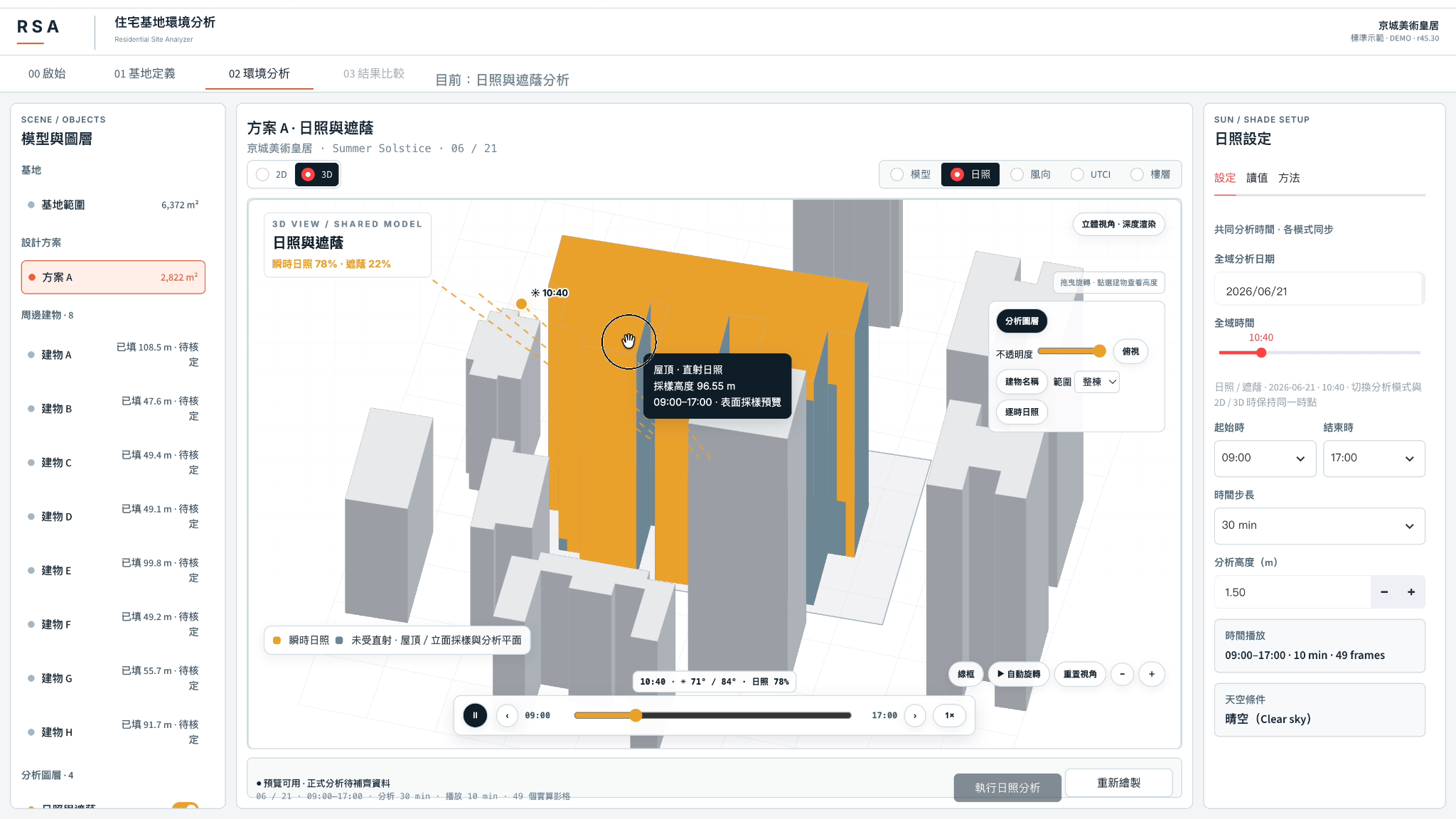
Time-based direct solar and shading patterns, with relationships to neighboring massing and building levels.
Residential Site Analyzer (RSA) explores how environmental simulation can become more explainable, traceable and useful during early-stage residential design.
RSA investigates a critical gap between specialist environmental computation and design decisions: how can evidence be communicated clearly while preserving methods, assumptions and uncertainty?
Time-based direct solar and shading patterns, with relationships to neighboring massing and building levels.
Exploratory visualization of prevailing wind and airflow relationships; not a validated CFD substitute.
Outdoor thermal-comfort interpretation, including sun-exposed versus shaded conditions and documented inputs.
Five unaltered interface screenshots from the active RSA research prototype, showing the connected process from site definition to environmental analysis. Some functions remain exploratory or under validation.
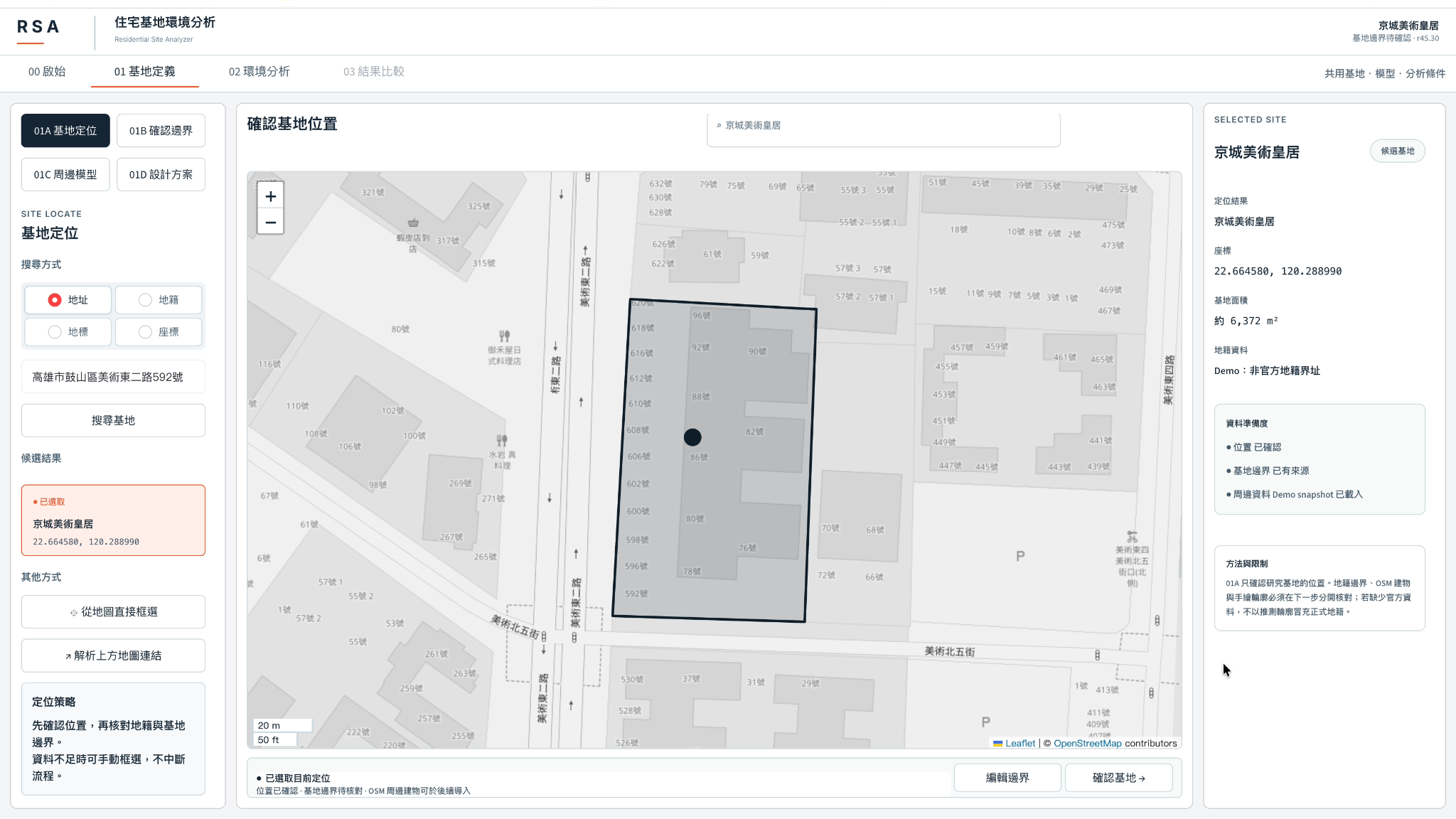
Confirm the selected site, review the mapped site boundary and document the baseline geometry for subsequent analysis. The example site is a research demonstration and must not be treated as an authoritative cadastral survey.
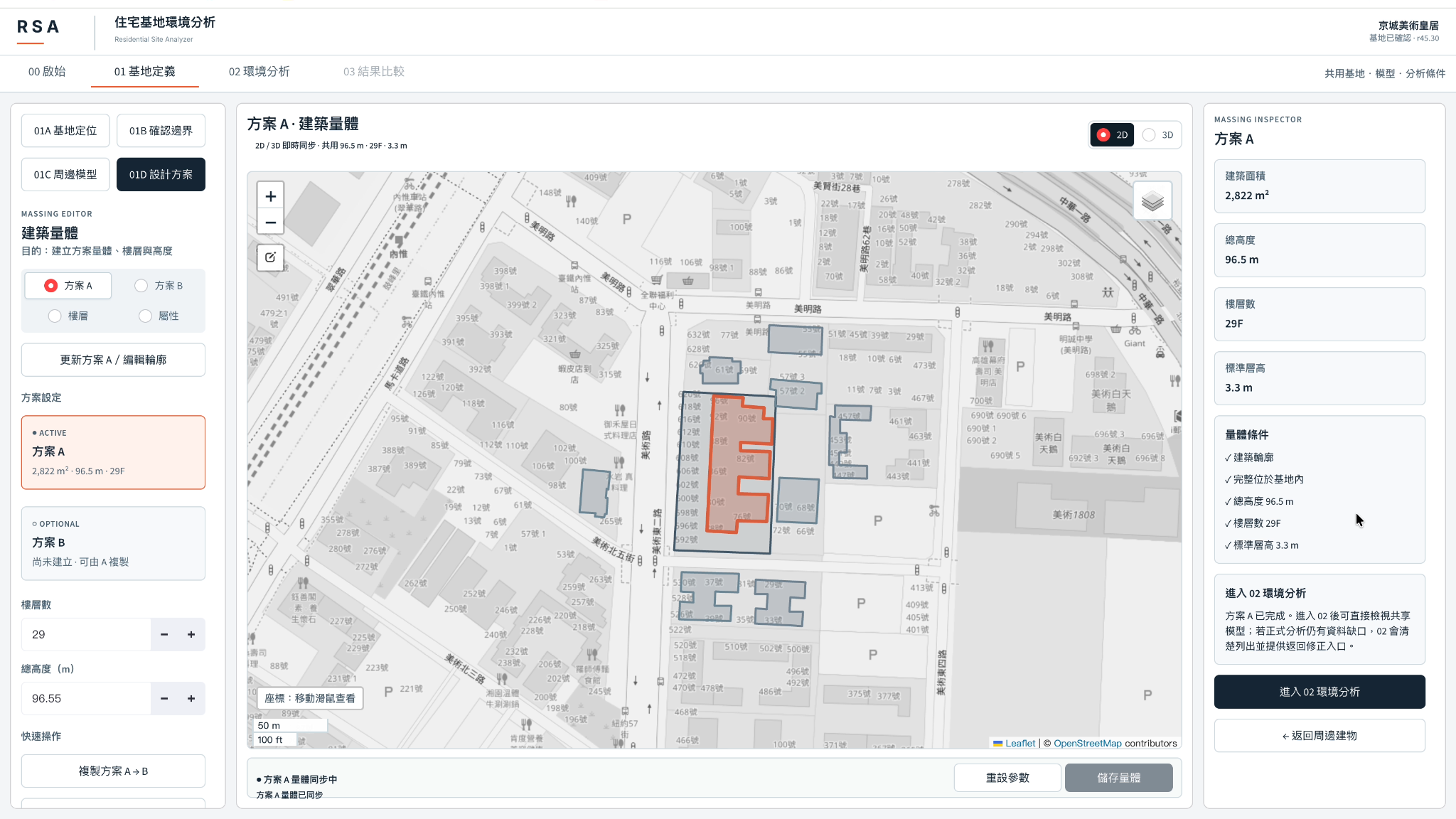
Set building footprint, height and floor count while reviewing surroundings and preserving explicit scenario inputs.
Inspect temporal direct-sun and shading patterns on the building model, including configurable time, analysis height and 2D/3D views.
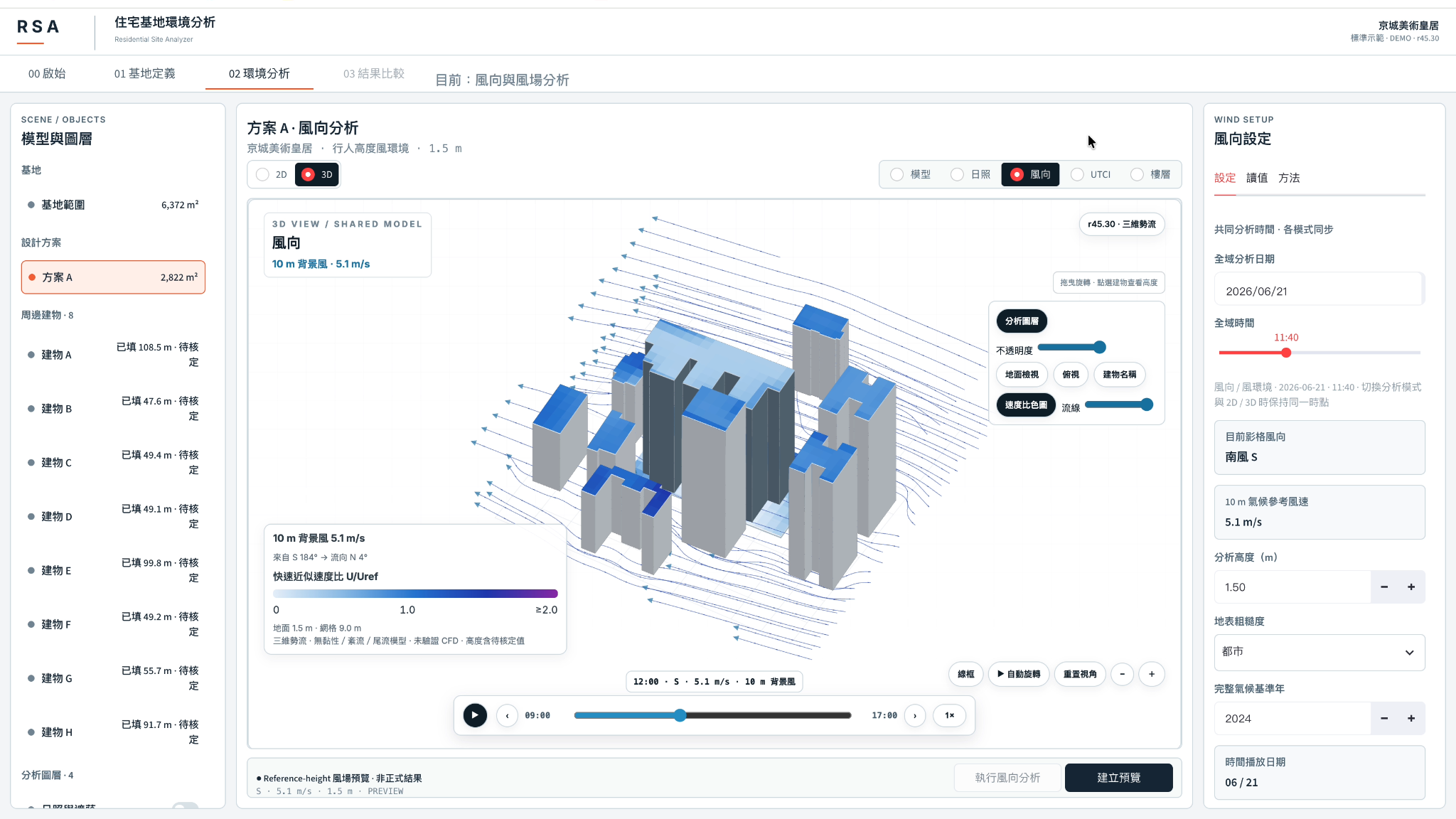
Explore reference-height wind direction, indicative airflow paths and building massing. The shown preview is explicitly non-CFD and should not be used for engineering sign-off.
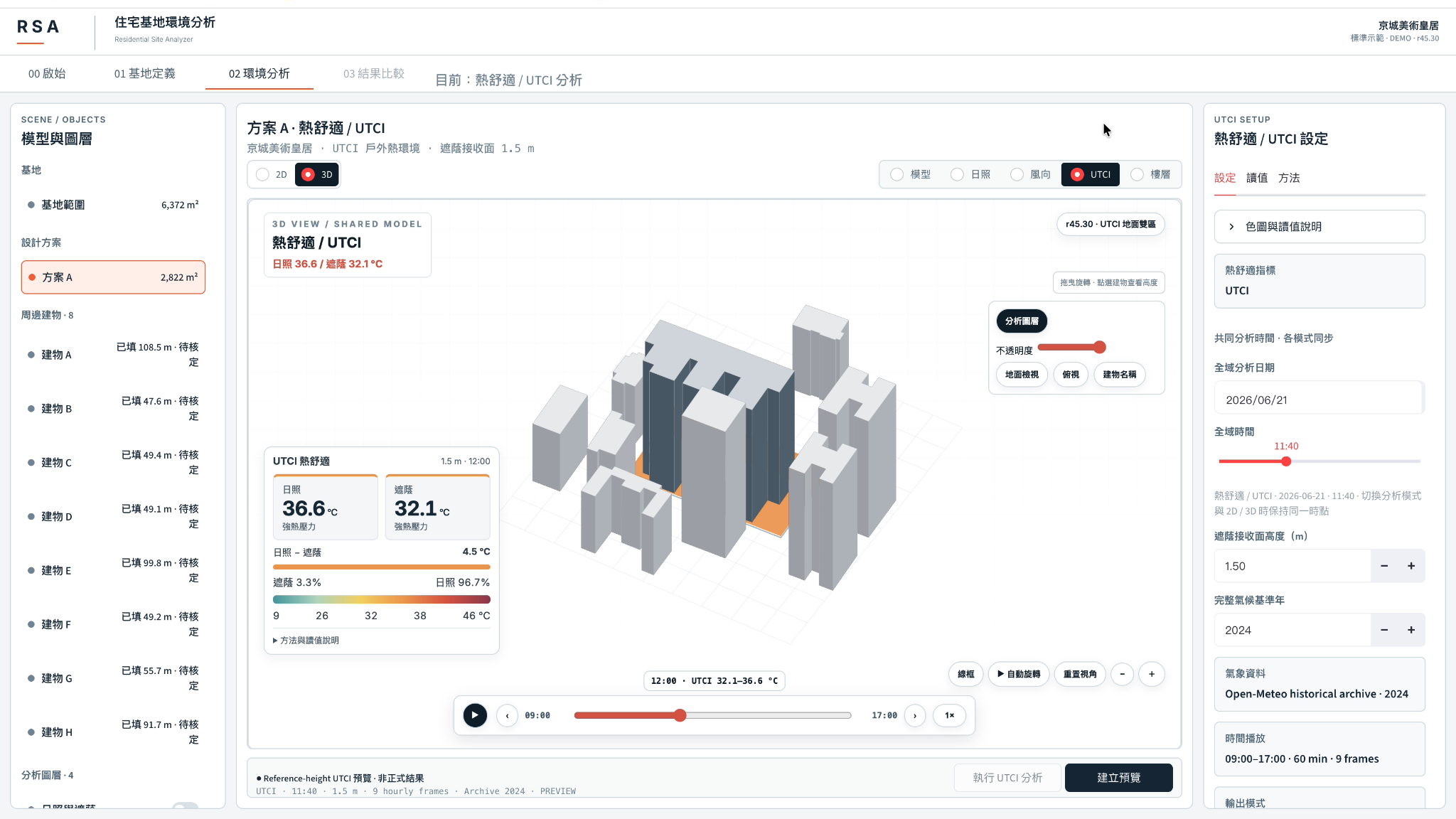
Inspect UTCI-oriented sun/shade comparisons, thermal stress interpretation, representative analysis heights and recorded climate-data conditions.
RSA organizes environmental information into a traceable workflow, while separating quantitative computation from explanatory interpretation.
Set up site geometry, adjacent buildings and design assumptions with source information.
Investigate solar/shading, wind-related context and thermal comfort at selected spatial and temporal scales.
Present readable spatial views and data summaries alongside uncertainty and validation status.
Study whether clearer environmental information improves user interpretation and early-stage design choices.
Historical RSA development records contain measured milestones. Figures below are associated with earlier versions and are not represented as current-release certification or complete-system validation.
Recorded direct-shadow intersection-over-union against a Radiance reference; 3/3 recorded cases marked PASS.
Recorded shadow-boundary Hausdorff distance, with an approximate area bias of −2.05% under that comparison setup.
Tests marked PASS in the r44 historical record; newer versions require fresh regression testing.
Python and Streamlit underpin the prototype’s integrated research interface. Development includes map-based site setup, building massing, environmental visualization, time controls and reporting-oriented evidence.
Project documentation references OpenStreetMap, Taiwan NLSC / official 3D sources where applicable, climate references including CWA and ERA5, and manual audit processes. The demonstration UTCI view labels Open-Meteo historical archive data.
Data source presence in research documentation does not imply every API connection is live, authoritative or already fully validated.
A planned Claude API integration would help people read environmental evidence without replacing the underlying numerical analysis, source records or professional judgment.
Convert structured model results, configuration settings and limitations into plain-language explanations. Distinguish computed values from AI-generated interpretation.
Summarize floor-level and scenario differences, flag data gaps, draft reviewable environmental reports and preserve references back to inputs and outputs.
Residential Site Analyzer is led and developed by Yu-Jyun Chiu (CHIU YU JYUN) in connection with graduate architectural studies at the National University of Kaohsiung, Taiwan.
RSA is currently an independently developed research prototype and is not an incorporated company. Academic affiliation does not imply formal university sponsorship, endorsement, or authorization to represent the institution.